

166 AI regulations, 80 risks, 116 controls mapped and kept current.
Cross-walk the EU AI Act to NIST RMF, ISO 42001, HITRUST, and your own controls — in one place, continuously updated.







AI Governance lives in 14 places at once. None of them agree.
Most GRC and AI teams cross-walk frameworks in spreadsheets — and the spreadsheets are out of date the day they’re built. Gaps in coverage become gaps in compliance.
One reference layer. Every framework. Always current.
The AI Governance Insights Hub maps every major AI regulation, risk, and control to every other one — so your team stops re-doing the same cross-walk every quarter.
The Hub doesn’t replace your AI Governance program. It’s the reference layer that makes yours faster to build and easier to defend. Built for the teams who get the audit request on Friday afternoon.
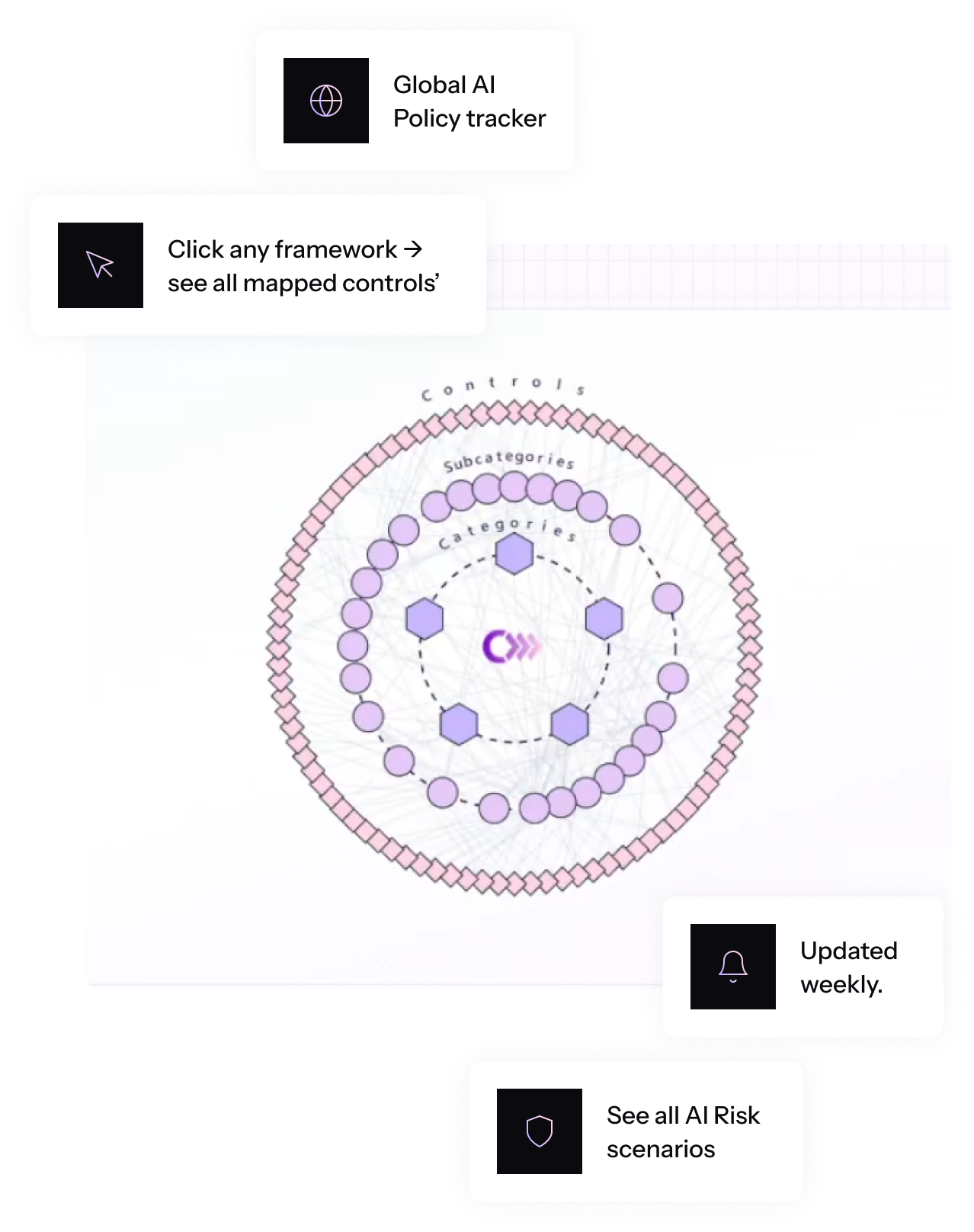
The largest curated AI Governance dataset, anywhere
Every entry is mapped, versioned, and dated. So when an EU AI Act amendment lands on Tuesday, your cross-walk reflects it by Friday.

Policies
Global AI regulations mapped with requirements and timelines

Risks
Harmonized AI risk taxonomy with scenarios and mitigations

Controls
Governance controls mapped to risks and policy requirements
"The information you need to govern AI well already exists — it's just scattered across dozens of frameworks. We built the Insight Hub because that synthesis shouldn't be a competitive advantage. It should be the shared foundation the whole field works from."

Replace the spreadsheets, the PDFs, and the guesswork
We centralize policies, risks, and controls into one visual system so your team can align AI compliance without spreadsheets.

Unified AI Governance Framework
Policies, risks, and controls connected to every major global AI regulation, with context, requirements, timelines, and inter-framework relationships.

Harmonized Risk &
Control Mapping
Standardized AI risk categories show how each risk, scenario, and control maps to regulatory requirements. We did the cross-referencing so you don’t have to.


Intuitive, Visual Exploration Experience
Interactive maps and relationship graphs so your team can move between regulations, risks, and controls in clicks, not spreadsheets.

Frequently Asked Questions
Here you can find the most common questions about AI Governance, AI Regulations and how to stay compliant in the age of Agentic AI.
Is the AI Governance Insight Hub really free?
Yes. Full access to all 166 regulations, 80 risk categories, and 116 controls is free, with no gated tiers on the core mapping. The Hub is designed as a shared reference layer for the AI Governance community with the foundational mapping every compliance and risk team needs, regardless of which Governance platform they use.
How often is the Insight Hub updated?
The Insight Hub is updated continuously by our AI Governance Experts. AI regulations evolve rapidly: new laws, amendments, and enforcement guidance appear across multiple jurisdictions every month. Credo AI's research team monitors regulatory bodies, standards organizations, and enforcement actions worldwide, refreshing mappings as changes occur so teams are never working from a stale compliance picture.
What controls reduce AI risk most effectively?
The most effective AI controls span five domains: AI Governance, human-AI interaction, operational processes, technical security, and transparency. The right mix depends on AI use case and risk profile, with a high-stakes application like credit scoring or healthcare diagnostics needing stronger transparency and human-oversight controls than a low-risk internal tool.
The Insight Hub catalogs 116 controls across these domains, each mapped to the risks it mitigates and the regulations it satisfies, so teams can prioritize by both risk reduction and regulatory leverage.
What AI risks should my organization be managing?
Organizations should be managing AI risks across ten primary categories: AI agency and autonomy, fairness and bias, privacy, security, harmful content generation, malicious use, information integrity, third-party and vendor risk, environmental impact, and societal harm. Which of these matters most depends on industry, AI use cases, and the jurisdictions where you operate.
The Insight Hub catalogs 80 risk categories in total, each mapped to the regulations that require their mitigation and the controls that address them, so teams can prioritize by both severity and regulatory leverage.
If you want to dive deeper into which risks you should be managing within your organization, contact our Advisory team for a full deepdive.
How do I crosswalk the EU AI Act to NIST AI RMF, ISO 42001, and my internal controls?
Crosswalking means mapping the requirements, risks, and controls from one framework to equivalent elements in another, so a single implemented control can be traced to every regulation it satisfies.
For example, a transparency control required under the EU AI Act often fulfills requirements in NIST AI RMF's MAP function and ISO 42001's risk treatment clause simultaneously.
The Insight Hub maps all 166 regulations to a unified library of 80 risks and 116 controls, eliminating duplicate work and producing audit-ready coverage across multiple regimes at once.
What AI laws are in effect in my region?
The Insight Hub maps regulations by country, state, and economic bloc, so you can instantly see what's active, what's pending, and what's proposed in your jurisdiction. This includes federal, state-level, and sector-specific rules that often get missed in single-source trackers.
Which AI regulations exist globally right now?
We currently track 166 AI regulations, frameworks, and standards across every major jurisdiction, including the EU AI Act, NIST AI RMF, ISO 42001, HITRUST AI, Colorado AI Act, and emerging laws in APAC and LATAM. The list is updated continuously as new regulations are passed or amended.
What AI regulations apply to my company?
It depends on where you operate, your industry, and how you deploy AI — a US healthcare company faces different obligations than an EU financial services firm. The Insight Hub lets you filter all 166 mapped regulations by geography, sector, and AI use case so you can see exactly what applies to you.
Done exploring? Here’s what’s next.
If the Hub showed you a gap in your program, GAIA is how Credo AI customers close it. Or keep using the Hub; it stays free.



The trusted leader in AI governance. Helping enterprises govern agentic AI systems at scale.


